AI Architecture: Three Meanings, One Confusion, and What Matters for Architects
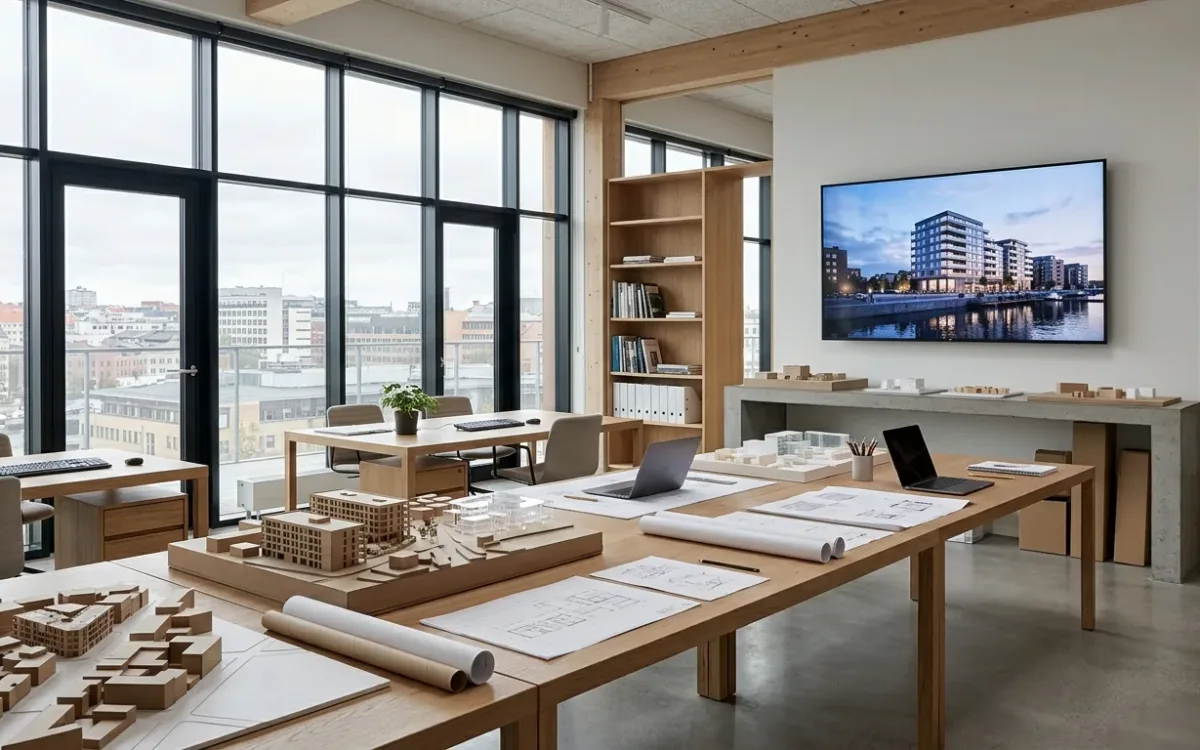
AI architecture means 3 unrelated things, and the collision produces some of the most confused search results on the internet. It can mean the architecture of AI systems, AI that designs buildings, or AI that visualizes buildings. If you are a practicing architect, the first one is noise, and the difference between the other 2 decides which tools belong in your office. Here are all 3, separated cleanly, then what AI actually changes for a practice today with the marketing removed.
AI architecture, meaning 1: the architecture of AI systems
In software, "AI architecture" means the design of AI systems themselves: neural network architectures, transformer variants, the system design of machine learning platforms.
A legitimate and enormous field. It has nothing to do with buildings. If that is what you came for, you want a software engineering resource, and everything below is about the other 2 meanings.
This collision is also why the phrase returns chaos in search. Two industries share one term and neither is going to give it up.
AI architecture, meaning 2: AI that designs buildings
In the generative design sense, "AI architecture" means AI that invents buildings: you give it a prompt or a set of constraints, and it returns massing options, plan diagrams or concept imagery of buildings that did not previously exist.
Useful in a narrow window, early, when you want divergence before you hold a design position. Structurally limited after that. The output is unconstrained by your site, your program, your code requirements and your structural logic. And it is not your design. The full breakdown of that category, including where it genuinely helps, is in ai architecture generator.
AI architecture, meaning 3: AI that visualizes buildings
In the rendering sense, "AI architecture" means AI that visualizes a building you already designed: you give it your sketch, your CAD screenshot or your model export, and it returns a photorealistic image of that design in about 30 seconds.
No invention. No scene reconstruction. No render farm.
The test that separates meaning 2 from meaning 3: one invents the building, the other photographs the building you already drew.
Meaning 3 has by far the larger footprint in practice today, and the reason is economic rather than technical. It removes the cost barrier that kept visualization away from everyday design decisions.
Disclosure so you can weigh what follows: I build SecondRender, a tool in this third category, developed together with practicing architects after one of them asked whether an AI app of mine could render his CAD models.
What this actually changes for a practice, today
Cut past the panels and the keynotes, and the near-term reality is specific.
Visualization stops being rationed. The traditional image pipeline (craft software, hardware, asset libraries, days per image, or a $500 to $5,000 outsourcing invoice) meant most design decisions were made without any realistic image at all. Not because architects did not want one. Because no single decision justified the cost.
That is the visualization access gap: the majority of architectural decisions that get made without any image, because visualization was too expensive to apply to them. It is where AI lands first and hardest. A sketch rendered in 30 seconds means the client sees the roofline question while it is still a question.
Iteration becomes a presentation strategy. When the marginal image is nearly free, you show 3 real alternatives instead of defending one. Decisions made by comparison come back faster and hold better.
The craft tier continues, at the top, unthreatened. Art-directed flagship imagery and pixel-consistent view sets are a different product with a different quality bar, and the visualization artists who make them are not being replaced by a 30-second render. An archviz professional put the split better than I could: "we all love spending weeks on a single atmospheric shot, but the real market often demands something else: Speed." What AI absorbs is that second market. Routine, fast-turnaround, budget-constrained imagery, and above all the imagery that previously never got made at all.
The honest limits, because they are load-bearing. Generative output varies between runs. Carrying one design detail-perfect across many perspectives is still hard for every tool in the category, mine included. And none of it replaces architectural judgment about what to show, to whom, at which level of realism. Tools can engineer around the first 2 (fidelity modes, reusable styles). The third one is your job and stays your job.
What about AI designing the buildings themselves?
The honest current answer: generative design is a divergence aid, not an architect. It proposes plausible form without carrying responsibility for site, program, regulation, structure, budget or the client relationship, which is to say it does the part of architecture that was never the hard part.
The profession's real risk surface is narrower and less cinematic than the headlines. Fee pressure on routine deliverables. Clients who arrive with expectations already set by AI imagery. Practices that adopt cheap visualization outcompeting practices that ration it.
There is also a reason this is landing now rather than 5 years ago. The waiting, the cost, the competition, and clients who expect movie-grade imagery on a shrinking budget: 4 forces arriving at once. That is the render squeeze: the widening gap between what a client expects a visualization to look like and what they are willing to pay for it. Craft-priced rendering cannot close that gap, because its costs are structural, not careless. Working harder inside the old cost structure is not an answer, because the cost structure is the thing being squeezed.
Only one item on that risk list is something a practice can act on this quarter. The competitive line being drawn right now is not architects against AI. It is architects who can put a realistic image on any decision, at any stage, against architects who still spend the entire image budget on a single hero shot at the end. Same designs, same talent, different hit rate in the room. A practice that loses work here is not losing it to a machine. It is losing it to the practice down the road that stopped rationing images.
Where to go from here
If the visualization meaning is the one you came for: the complete guide to architectural rendering maps every production path and what it truly costs, archviz covers the profession and where AI honestly fits into it, and sketch to render is the concrete workflow from a drawing to a finished image.
The one-sentence version: for a working architect in 2026, AI architecture mostly means your own designs, visualized at the speed of the conversation. The fastest way to test that claim is a sketch of yours and 30 seconds.