How long does rendering take? Honest timings for architectural renders
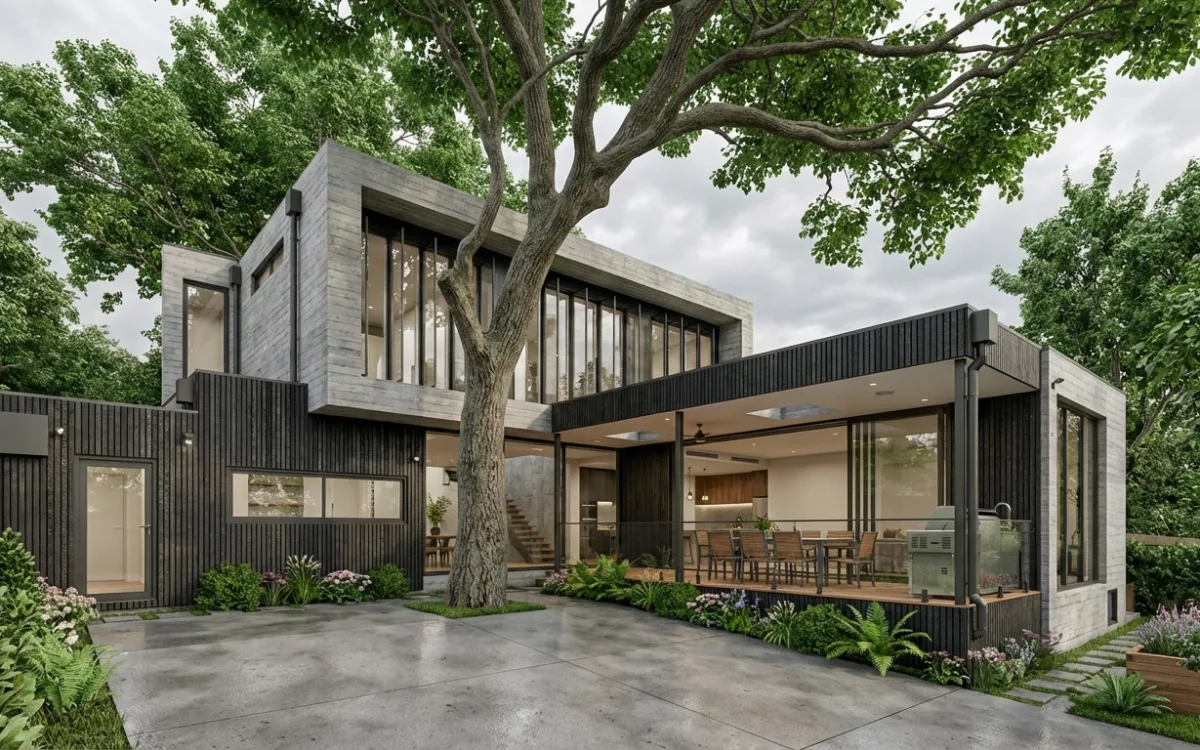
How long does rendering take? For one photorealistic architectural render on a normal workstation, typically minutes for a draft pass and hours for a final frame, with heavy exterior or interior scenes running overnight. Draft previews are typically minutes. Animation is a different order of magnitude again, because you are paying that price per frame.
That is the honest answer to the narrow question. It is also misleading, because the render itself is almost never what costs you the week.
I build AI rendering software with practicing architects. An architect saw an AI app I had built for another industry and asked whether it could render his CAD models into photorealistic images. I said yes, then spent 2 weeks finding out what yes required. The pattern since then has been consistent: architects ask about render time, but the loop around the render eats the deadline.
How long does rendering take for a single architectural render
Compute time depends on a short list of variables. Each one is set before you press the button:
- Resolution and sample count. Doubling the long edge roughly quadruples the pixels you are paying for. Sample count is the direct dial between noise and time.
- Global illumination and bounced light. This is the expensive part. It is also the part that makes an image convincing, which is why nobody turns it off.
- Interior versus exterior. Interiors typically take longer at equal quality. Light gets into an interior by bouncing, and every bounce is more work.
- Scene complexity. Vegetation, glass, water, fabric, high polygon entourage. Each one adds time that has nothing to do with your design.
- Hardware. A workstation GPU against an ageing laptop is not a small difference. For most firms, a dedicated render farm is not a realistic line item.
The range is wide. A quick studio check render, minutes. A client-facing final frame from a resolved scene, typically hours. A demanding scene at presentation resolution, overnight. At 8am, you find out whether it worked.
Real-time rendering software changes that arithmetic by moving the cost: you get an image per frame instead of per hour, and you pay for it in scene preparation, optimisation and hardware. The bill does not disappear. It moves upstream.
The clock starts long before you press render
The render time number leaves out the setup. Before a traditional renderer can produce anything, you have to hand it a reconstructed world: geometry clean enough to light, physically based materials for every visible surface, a lighting rig that behaves, and entourage at the right scale.
My first customers came from exactly that workflow. Hours of rendering after days or weeks working on materials, lights and shadows. That is not a criticism of their craft. It is what reconstruction costs. A render engine knows the equations and the values you give it. Everything convincing in the final image must be supplied by you, in advance and correctly.
Measured properly, the answer to "how long does rendering take" for the first presentable image of a new project is usually not hours. It is days. The render occupies only the final few hours. This is the part of architectural rendering that software comparisons leave out, and it is where most rendering bottlenecks live.
How long does rendering take across the whole revision loop
Now add what your deadline actually measures: revision rounds.
A client says "make the facade lighter" or "try the other cladding". In compute terms, that is trivial. In workflow terms, you return to the scene, adjust the materials, check the lighting, render again, then redo the post-production pass. The previous grade was tuned to the previous image. Each round means fresh setup, rendering and polish.
Outsource it and compute time stops being your problem, but latency gets worse. Brief, wait, receive, review, write revision notes, wait again. Each iteration can consume days of calendar time. The design conversation stalls between images. The value of a render was never the file. It is the loop.
The honest unit is calendar time, not compute time. Three revision rounds on a 4 hour render do not mean 12 hours of project time. They can consume a fortnight. That is why "one shot, make it count" became the default economics of architectural visualization. Nobody chose that workflow. The price of each render forced it. Single-option client presentations are what that price bought.
Why the honest answer keeps getting less acceptable
The timings above have not changed much in years. What changed is what they have to fit inside.
Four forces are hitting the practicing architect at once: the waiting, the cost, the competition, and customers who expect the quality they see everywhere while budgets move the other way.
The render squeeze is the widening gap between what clients expect a visualization to look like and what they are willing to pay for it, which craft-priced rendering cannot close.
Craft-priced rendering cannot close the gap because its cost is structural. The hours are reconstruction hours. Working harder inside that structure does not change it. The cost side of architectural rendering is where the squeeze shows up first.
Two renders, two different clocks
Part of the confusion in this question is that we use one word for two products.
An archviz professional put it plainly: "we all love spending weeks on a single atmospheric shot, but the real market often demands something else: Speed". The same community says: "clients usually have extremely tight deadlines."
A communication render and a portfolio render are two different artifacts: one supports a decision inside a live design process, the other is a finished piece, and they carry different quality bars and different economics.
The two week atmospheric shot is not waste. It is the best work our industry produces, priced accordingly. But most images a practicing architect needs are decision support: does this massing work, does the client understand the courtyard, which cladding goes into Thursday's meeting? Those images have deadlines. Hold them to portfolio timings and they often never get made.
How long does rendering take with AI in the loop
For SecondRender, about 30 seconds. Sketch in, photorealistic render out. No render farm, no overnight wait.
The number matters less than what it does to the loop. When an image takes about 30 seconds instead of a day, showing the client three cladding options is no longer a budget decision. The render moves from the end of the process to the middle, where decisions are still cheap to change.
What AI rendering does not fix
Three limits are real. They are properties of the whole category of AI image models, not quirks of one product, and you should hear them from me rather than discover them at 11pm.
Consistency and predictability. The same input does not guarantee the same output. That is the trade generative models make. Saved styles and fidelity mode manage it by keeping the source authoritative. They do not eliminate it. If you need a pixel-identical rerun of last month's image, that expectation belongs to a different technology.
Cross-perspective style transfer. You render an object with exactly the details you want, then need those details carried into another perspective. That is still a challenge. It is an honest edge of this field today.
Iteration regression. Feed AI generations back in as sources and quality degrades across rounds. This failure mode gives AI rendering its reputation for going soft after repeated passes. The defence is a pipeline where the original source stays authoritative instead of each output becoming the next input. That is how SecondRender is built.
One limit is not technical. This does not produce what a high-end visualization studio produces, and it is not meant to. Those artists do a different job at a different level. What AI rendering changes is access. For most architects, the alternative to an AI render was never a studio image. It was no image, with a client squinting at a plan.
The real answer to how long rendering takes is the length of your iteration loop, multiplied by the rounds the design honestly needs. Shorten one render and you save an afternoon. Shorten the loop and you change what the design process can afford to ask.
Book a free 30-minute demo. I will show you a live render from scratch and answer every question.