3D Interior Rendering Services: Costs, Turnaround, and When Not to Outsource
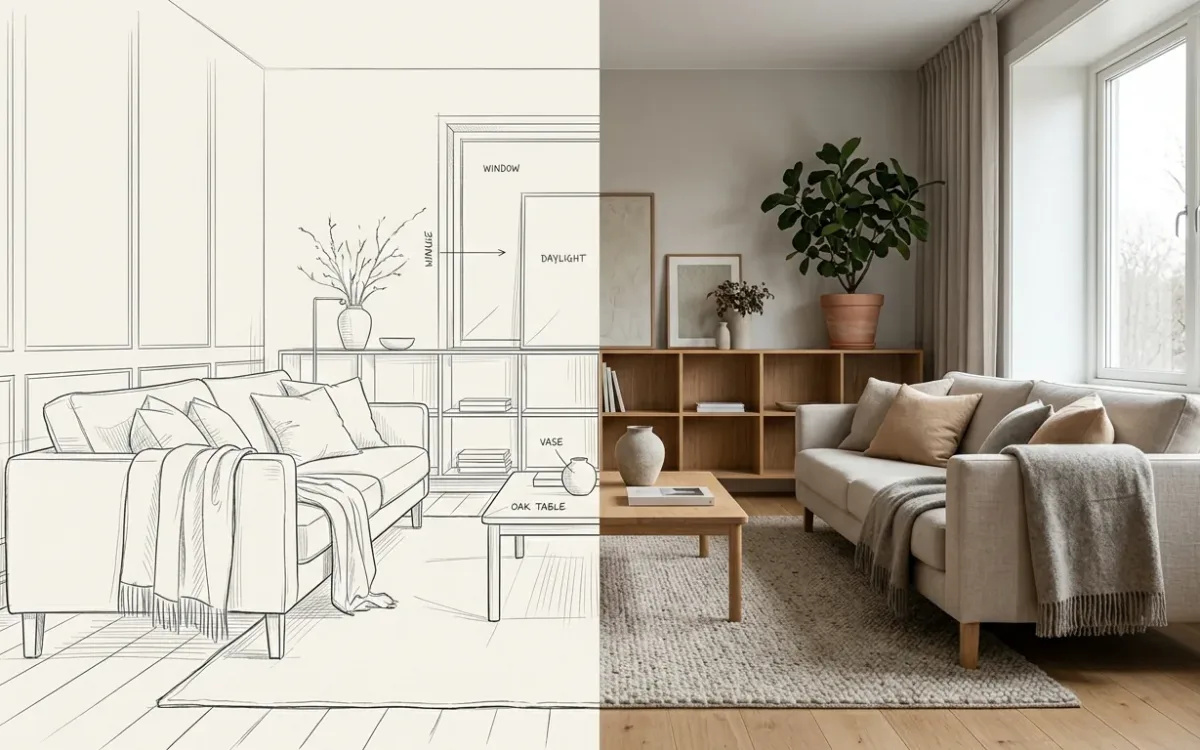
3D interior rendering services charge $300 to $2,000+ per still and take 3 days to 3 weeks, and the invoice is the smallest of the three costs you pay. The second is the briefing labor, and that one lands on you. The third decides whether outsourcing was the right call at all: the feedback loop. Interior projects generate revisions the way exteriors never do, and every revision travels through somebody else's queue. Below are the real market numbers, the briefing discipline that keeps them from doubling, and a clear rule for when not to outsource in the first place.
What 3D interior rendering services cost
Per still: $300 to $800 from capable offshore studios, $800 to $2,000+ from established studios in Western markets, more for complex hospitality and retail scenes. Per revision: 2 to 3 rounds typically included, then $50 to $150 per round, or hourly. Turnaround: 3 to 10 business days for first images, 1 to 3 days per revision round. Animations and walkthroughs: $2,000 to $15,000+, depending on length and quality tier.
The spread is that wide because an interior still prices on three separate things. Detail density (a bedroom with 8 objects versus a restaurant with 200). Lighting complexity (daylight only versus mixed artificial). And whether the studio models your custom furniture or dresses the scene from libraries. Two studios quoting the same room can be quoting two different jobs, which is why the cheap quote is sometimes the honest one and sometimes the incomplete one.
Why interiors generate more revisions than exteriors
Structural, not accidental. An interior render encodes dozens of decisions your client can veto one at a time. Fabric. Finish. Fixture. Wall color. Rug. Artwork. The exact warmth of the evening light. An exterior render encodes a handful of big decisions; an interior render encodes a catalog.
Each veto is a revision. Each revision is days of latency and, past the included rounds, money. The meeting where your client says "warmer, and what if the island were oak?" happens on Tuesday. The updated image arrives Friday. The conversation and the imagery run on different clocks, and the conversation is the one with the deadline.
That is the honest core of the outsourcing decision, so it deserves a name.
The iteration loop is the cycle from question to image to reaction, and it is where visualization creates value during design rather than after it.
Outsourcing buys image quality and breaks that loop. Sometimes the trade is right. Knowing which times is the skill.
When 3D interior rendering services are the right call
- The image is the deliverable. Marketing imagery, show units, hospitality brochures. Art-directed, magazine-grade, worth a studio's craft and your patience.
- The design is finished. No open decisions means no loop to break. End-stage hero images outsource cleanly.
- One-off capacity. No rendering capability in-house and a single presentation to win: a freelancer or a studio beats building infrastructure for one job.
- Custom modeling at scale. A studio that models your bespoke joinery accurately is doing work no fast tool replicates. That is craft, and craft is what you are paying for.
When they are the wrong call
- Mid-design client alignment. If the image exists to decide something (the floor, the light plan, the layout), a days-long loop defeats its purpose. By the time the render arrives, the meeting happened. Architects describe the pressure around that wait the same way every time: "clients usually have extremely tight deadlines."
- Options work. Showing 3 material directions means 3 briefs, 3 invoices, 3 queues. The economics push you back to presenting 1 direction, which was the problem you were trying to solve.
- Anything on a weekly cadence. Recurring presentation needs turn per-image pricing into the most expensive subscription you will ever hold.
For the loop-dependent work, the alternatives are in-house real-time rendering (realistic if full models and GPUs are already part of your practice) or the newer AI rendering tier, which turns drawings and screenshots into interior imagery while the meeting is still running. Neither is free of trade-offs, and the AI ones are worth stating before a deadline states them for you: the same input does not guarantee the same output, and carrying one object, detail for detail, from one perspective into another is still hard. The honest comparison of every production path is in 3d rendering for interior design.
One thing worth saying plainly, because the price list hides it: for a great many interior decisions, the alternative to outsourcing was never a studio image. It was no image, and the decision got made from a floor plan and a hunch.
The briefing discipline that protects your budget
Studios are not mind readers, and interior revisions are where budgets die. Your brief is the real contract.
- Photos beat adjectives. "Warm minimalism" means nothing. 5 photos of what you mean means everything. Send the counter-examples too, the rooms you do not want. They kill entire revision rounds before they start.
- Lock the camera first. Approve viewpoint and framing on a draft, or even on a phone snapshot of your model, before anyone polishes anything. Late camera changes are the most expensive revision type there is.
- Specify every material with codes and links, not names. "Oak" is 40 products.
- Name the light. Time of day, mood, which fixtures are on. Lighting revisions are the second most expensive type.
- Stage the approvals. Clay or draft render, then camera and composition sign-off, then a materials pass, then final lighting polish. A studio that resists staged approval is optimizing its queue, not your outcome.
- Put the revision definition in writing. What counts as one round, what reopens scope (camera, geometry), what the overage rate is. The disputes are never about the first image.
Items 1 and 2 do most of the work. An hour spent assembling photos and fixing the camera is the cheapest hour in the entire project, and it is the hour everyone skips because the deadline is Thursday.
The rule of thumb
Price the decision, not the image. A $1,200 marketing still that pre-sells a development is cheap. A $600 render commissioned to settle a kitchen island is a broken loop wearing an invoice, and the honest historical outcome was that the island got decided from a sample chip while everyone waited for the render.
So, the shortest version I can give you: outsource the endings. Keep the middle of your design process on a loop you control, whatever tool that loop runs on.
Wider context: 3d rendering for interior design for the full production landscape, and architectural rendering cost for how these numbers compare across the whole field.